.png)
Beijing imposed a national security law on Hong Kong in 2020, after sometimes-violent democracy protests the year before.
The new law criminalised four categories of offences: secession, subversion, terrorism and foreign collusion, making the offences punishable with up to life in prison.
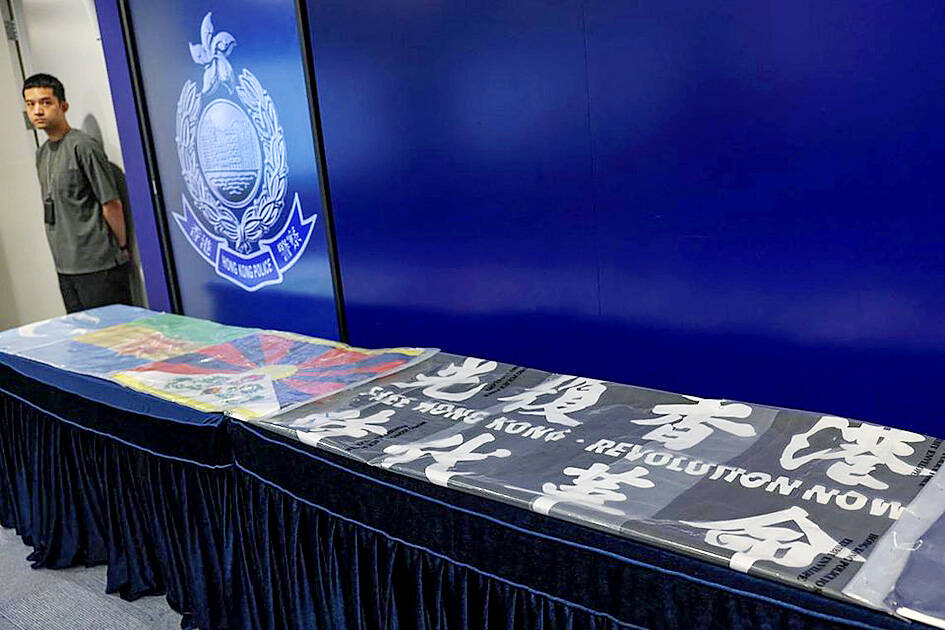
PHOTO: REUTERS
Chief Superintendent Steve Li said four males aged between 15 and 47 were arrested on Wednesday for “conspiracy to subvert state power”.
They played various roles in a group established in Taiwan in November that later called for the overthrow of the Chinese Communist Party, Li said.
“They said they would seek international support and provide military training to Hongkongers abroad,” Li told reporters.
A Facebook page matching the Chinese name of the group identified by police had fewer than 70 followers.
Police also displayed flags seized during Wednesday’s operation, including one of Tibet and one bearing a slogan outlawed by Hong Kong authorities.
The four people remained in custody on Thursday.
In response, the group condemned the government for what it called abusing the security law and suppressing freedom and human rights. It said on its Facebook page that it would not remain silent.
Hong Kong enacted a separate national security law of its own last year, which officials said was needed to restore order.
As of July 1, authorities had arrested 333 people for various national security crimes, with 165 of them convicted.
Beijing’s top official overseeing Hong Kong, Xia Baolong, said last month the city must remain on guard for national security threats and “soft resistance”.
Critics said the crackdown under the national security law imposed in 2020 has stifled the city’s freedom of expression and other Western-style civil liberties that Beijing promised to keep intact when Hong Kong returned to its rule in 1997.
ADDITIONAL REPORTING BY AP




 (1).jpg)
 (1).jpg)
 (1).jpg)
 (1).jpg)
 (1).jpg)